| Anne
V. Shepler |
 |
A mathematician is a blind man in a dark
room searching for a black cat which isn't there.
-- Charles R. Darwin
He
didn't live long enough to see my mathematical
vindication.
-- H.S.M.
Coxeter on E.C.
Escher
|
Professor of Mathematics,
University of North Texas
Office:
General Academic
Building 471B
Mailing Address:
Phone: (001) 940-565-2155
E-mail: ashepler  unt.edu
|
Why
does the mirror
reflect you left-right, and not up-down?
UPCOMING CONFERENCES:
Southwest Local Algebra Meeting SLAM
2023, at University of North Texas in Denton, March 4--5, 2023.
International Centre for Mathematical Sciences ICMS, Workshop on "Various
Guises of Reflection Arrangements", March 13--17, 2023,
Edinburgh, Scotland.
BEFORE YOU EMAIL ME:
| UNT students: put the course name and main
idea on the subject line! |
| UNT students: is the answer to your
question in the syllabus? |
| I don't respond to emails about private
tutoring (non UNT students), web development, or coding. |
| UNT Graduate students: nagging is allowed,
sometimes encouraged. |
| Letters of recommendation: best ask 2-6
weeks before due date, more time is required if over a break. |
I don't respond to emails asking about
research/lab positions;
these go to PhD students in math at UNT.
Post-doc positions are another story. |
WHY MATH?
Mathematics often has more in common with arts and music than other
scientific fields: We imagine what could be, possible universes that
could exist. Indeed, many people choose theoretical mathematics
because it requires more imagination
than any other field they have encountered. Saying
mathematics is about numbers is like saying literature is about
letters. Truly creative work takes flight after learning to use
the grammar of mathematics: work with relationships and functions and
theorems in a precise way. Undergrads: see Mark Tomforde's page
for students and math
majors in particular.
PUBLICATIONS:
preprints
and research papers.
|
ALGEBRA
SEMINAR:
includes ring theory, homological algebra, noncommutative
algebra, number theory, representation theory, and
combinatorics. |
TORA
Texas-Oklahoma Representations and Automorphic Forms
|
MATHEMATICAL
RESEARCH I work in pure
mathematics at intersections of algebra, combinatorics, geometry, and
representation theory. Interests include noncommutative
algebra, reflection groups, invariant theory, homological algebra,
deformation theory, Hochschild cohomology, hyperplane arrangements,
and codes in computer science build on isometry groups.
Physicists often regard space as a Calabi-Yau
manifold endowed with symmetry. We model the local setting with a finite
group G acting linearly on a finite dimensional vector space V. We
mod out by symmetry to obtain the orbifold V/G which may have
singularities. Geometrically, we might replace V/G with a smooth
variety, but Hochschild cohomology recommends an algebraic approach:
replace the ring of invariant polynomials S^G with the natural
semi-direct product algebra S#G. Hochschild cohomology governs the
deformation theory and predicts various algebras important in
representation theory, combinatorics, and the geometry of orbifolds.
Reflection groups include the Weyl and Coxeter groups, complex
reflection groups (u.g.g.r.'s), and reflection groups over arbitrary
fields. Their study intertwines invariant theory, combinatorics,
and the arrangements of hyperplanes. (Scott Crass can explain
relations with Dynamical
Systems.)
My work has been supported by
Simons
Foundation:
Collaboration Grant for Mathematicians, Award Number
949953 (sole PI), 2022--2027
Collaboration Grant for Mathematicians, Award Number
429539 (sole PI), 2016--2022
National
Science Foundation :
Standard Research Grant (DMS-1101177), Principal
Investigator (sole PI), 2011--2014
Standard Research Grant (DMS-0800951), Principal
Investigator (sole PI), 2008--2011
Standard Research Grant (DMS 0402819), Principal
Investigator (sole PI), 2004--2008
Post-Doctoral Research Fellowship (Award 9971099),
Principal Investigator (sole
PI), 1999--2002
SLAM Conference Grant (DMS-2302498), Co-Principal Investigator, 2023
TORA Conference Grant
(DMS-1600642), Co-Principal Investigator,
2016--2019
TORA Conference Grant (DMS-1302770), Co-Principal
Investigator, 2013--2014
TORA Conference Grant (DMS-1132586), Co-Principal
Investigator, 2011--2012
National
Security Agency : Research
Grant, Principal Investigator (sole
PI), 2002--2004
Alexander
von Humboldt Foundation : Research
Fellowship (at RWTH Aachen University), Principal
Investigator (sole PI), 2009
Texas
Coordinating Board : Advanced
Research Program Grant, Principal Investigator (sole PI), 2008--2010
TALKS
ADVISING: Masters/PhD/Post-doc Advisor for
- Isaac Bancroft, current PhD student at UNT
- Dillon
Hanson, PhD 2023
- Colin
Lawson,PhD 2023
- Naomi
Krawzik, PhD 2020, tenure-track assistant professor at Sam
Houston State University
- Chelsea
Drescher PhD 2020, regular faculty at Phillips Exeter Academy
in New Hampshire
- Philip
Puente, PhD 2017, visiting assistant professor at Dartmouth
College, then Texas State University
- Elizabeth
Drellich, postdoc 2015--2016, visiting assistant professor at
Swarthmore College, then Haverford College, Philadelphia
- Christine
Uhl, PhD 2016, associate professor (tenured) at St.
Bonaventure University in New York
- Tamara
Knox, MS 2013, senior workflow analyst at Finance of America
Holdings
- Connie
Chan, MS 2015, professor at Collin College, Texas
- Briana
Foster-Greenwood, PhD 2012, associate professor (tenured) at
California State Polytechnic University Pomona (Cal Poly Pomona)
- Paisa Seeluangsawat, BS from MIT, MS 2005 from
UNT, PhD 2011 from Univ. of South Carolina, software engineer at
Google
TORA
I'm
on the steering committee and organizer for conference series
TORA
= Texas-Oklahoma Representations and Automorphic
forms
supported
by the National Science Foundation and Oklahoma State University,
University of Oklahoma, and University of North Texas (UNT).
-
TORA I meeting: September 17--18,
2011, UNT. (Plenary speakers: Nils Skoruppa, Sol Friedberg,
Martin Raum.)
- TORA
IV meeting: March 23--24, 2013, UNT.
(Plenary speakers: Ken Ribet, Nolan Wallach, Susie Kimport.)
- TORA
VII meeting: April 8--10, 2016,
UNT. (Plenary
speakers: Vyjayanthi Chari, Kon Ono, Nickolas Andersen.)
- TORA
X meeting: April 5--5, 2019,
UNT. (Plenary
speakers: Ozlem Imamoglu, David Vogan, Olivia Beckwith.)
ALGEBRA
SYMPOSIA
(by and for grad students):
|
REUs
(undergrad research):
|
AWM The American Women for Mathematics
(AWM) organizes a workshop at the joint American
Mathematical Society and Mathematical
Association of America meetings each January, currently
supported by an NSF AWM
ADVANCE grant. Sarah Witherspoon and I organized the poster
session Jan 2017 and the workshop
Jan 2018 on Noncommutative
Algebra and Representation Theory
with speakers:
Chelsea Walton, Sian Fryer, Van
Nguyen, Gordana Todorov, Elizabeth Drellich, Khrystyna Serhiyenko,
Ellen Kirkman, Vyjayanthi
Chari, Julia Plavnik, Natasha Rozhkovskaya, Pamela Harris, Monica
Vazirani, Julia Pevtsova
Also see:
American
Mathematical Society (AMS) Special Sessions recently
co-organized:
- "Noncommutative Algebra and Representation
Theory" with Sarah Witherspoon, at Joint AMS/MAA national meetings,
also part of AWM workshop, San Diego, Jan 13, 2018.
- "Noncommutative and Homological Algebra" with
Sarah Witherspoon, in Denton, Texas, at University of North Texas,
Sept 9--10, 2017.
- "Noncommutative Algebra, Deformations, and
Hochschild Cohomology" with Sarah Witherspoon, in Lubbock at Texas
Tech Univ, April 11--13, 2014.
- "Combinatorial Avenues in Representation
Theory" with Nathaniel Thiem and Richard Green, in Boulder,
Colorado, April 13--14, 2013.
- "Hecke Algebras and Deformations in Geometry
and Topology" with Matt Douglass, in St. Paul, Minnesota, April
10--11, 2010.
ADVICE for PhD students in
math
WHY
MAKE AN APPT?
Outside of office
hours and giving lectures, your math instructor may be advising
graduate students, refereeing papers, writing grant proposals,
preparing manuscripts for publication, completing editorial work for
journals, reviewing budgets, writing talks, working with research
collaborators, reviewing university programs, writing reports,
designing new courses, grading papers, evaluating grant applications,
preparing lectures and exams, organizing conferences, reviewing
graduate and job applications, revising articles, writing letters of
recommendation, reviewing PhD theses, proof reading manuscripts,
attending department meetings, updating webpages, writing computer
code, completing mathematical computations, and proving
new theorems all in the same week. That is why many
instructors ask you to make an appointment instead of just dropping
by.
PERSONAL
I attended the honors college at Valparaiso
University---a small liberal arts school in Indiana. I
minored in the humanities, co-founded a comedy troupe, participated in
many theatre productions, and worked for the music department as a
piano accompanist. I decided to major in math after
participating in a Research Experience for Undergraduates program at
the University of Oklahoma with
Murad Özaydın and Andy Miller. I also spent a semester at Hangzhou
University in China (took Chinese language classes and also
taught English at the Y.M.C.A.). Afterwards, I moved to
California for grad school and scuba
diving. Moray
eels provide nice examples for constructing orbifolds.
Maybe not the wolf
eel. And, in case you were wondering, Pixies acoustic "Where Is My Mind"
sounds great on the Mason
and Hamlin BB with Isaac
hammers unless you are half Boxer, half lab.
Hyperbolic
Space:
Reflection groups and modular forms:
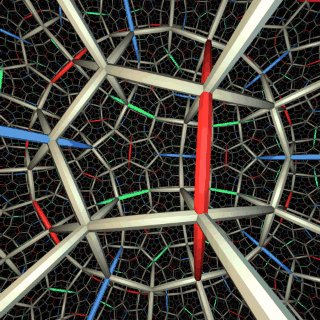
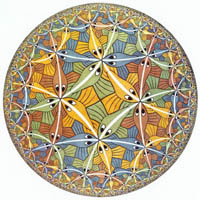
Images by Douglas Dunham (University of
Minnesota at Duluth), and Charlie Gunn with The Geometry Center
(Univ of Minnesota).
Coxeter says of Escher's print: "He got it
absolutely right to the millimetre, absolutely to the millimetre.
... Unfortunately, he didn't live long enough to see my mathematical
vindication."